

In Moscow, restrictions on mobile internet are expected to take effect around May 9, 2026. The key dates for these restrictions may be May 5, 7, and 9. Sources of Russian independent media say that the scale may be broader than in previous instances.
On May 5th, Moscow residents had problems even with the “white list” resources. The BBC said that the authorities can turn off mobile internet between 5 AM and 12PM on the 7th of May, and between 5 AM and 1PM on the 9th of May, during the Victory Day parade rehearsal and the parade itself, respectively.
Since the start of the full-scale war against Ukraine, communication restrictions in Russia have been increasingly used as a “security regime” tool around politically and symbolically significant events.
For example, in 2025, Moscow residents already faced large-scale restrictions on mobile internet ahead of Victory Day celebrations. In March 2026, similar limitations on mobile communication were again recorded in Moscow. At those times, only resources from so-called “whitelists” remained more or less accessible. Similar shutdowns have also been documented in other regions. Some were temporary (Saint Petersburg), some are on a permanent basis (Vladimir).
What Is Happening
Restrictions first reported in late April
On April 28, reports from sources in the telecom sector and Russian government circles indicated that the authorities were preparing “more extensive” communications restrictions than usual ahead of the Victory Day parade. The news outlet The Moscow Times reported that these restrictions could affect not only mobile internet, but also SMS delivery and even “whitelisted” resources. Furthermore, signal jamming might cover the entire area within the Moscow Ring Road.
Additional context: Russian authorities officially announced that the parade would be held in a “reduced format,” without a column of military vehicles. Vladimir Putin’s press secretary Dmitry Peskov linked this to the “operational situation” and the need to minimize threats. This stops short of confirming shutdowns, but signals a high-security regime where communications restrictions are the norm
Shutdowns became common practice across Russian regions in 2025. In March 2026, large-scale, prolonged mobile internet outages affected Moscow.
On May 3, the situation entered a new phase. Subscribers in Moscow began receiving notifications from telecom providers about temporary restrictions on mobile internet and SMS from May 5 to May 9, “to ensure security measures.” Meduza (an independent Russian news outlet based abroad) reported that Beeline (one of the major Russian telecom providers) confirmed this information and recommended that users rely on Wi-Fi for internet access.
Subscribers of MegaFon and Yota in St. Petersburg received similar messages regarding possible “difficulties” with mobile internet. However, in this city the “official” connection issues were limited to May 9 only.
On May 4, Istories (Important Stories) reported, citing foreign intelligence data and a source close to the security services, that the strict measures were driven by concerns over a potential assassination attempt against Vladimir Putin. Quoting foreign intelligence data and a source close to the security services, the outlet reported that, in particular, the March 2026 shutdowns were ordered not by the FSB (Federal Security Service) but by the FSO (Federal Protective Service), the agency responsible for protecting senior officials and politicians.
Update, May 5, 9:09 a.m. Shutdowns have begun: first field data
According to Downdetector and sboy.rf (Russian outage-tracking services), a sharp spike in complaints regarding non-functional mobile internet was recorded in Moscow on the morning of May 5. Users report that messengers and websites do not open, mobile connectivity is down, and even resources from the “whitelist” are inaccessible.
Msk1 reports that its journalists lost mobile connectivity entirely and could not access even services from the “whitelist.” In other words, the shutdown appears to be stricter than the March scenario, as expected.
In St. Petersburg, according to Fontanka, only websites and apps from the “whitelist” are working. Fontanka also noted that the situation coincided with a recent Ukrainian drone strike: 29 drones were shot down in Leningrad Oblast overnight.
May 5, 12:04 p.m. RBC: outages hit banks, spread beyond the Moscow Ring Road
According to RBC (a major Russian business news agency), the morning restrictions affected subscribers of MTS, T2, Beeline, and Yota communications brands. For T2, disruptions extended to the Moscow region, indicating a wider geographical reach.
In addition to messengers and websites from the “whitelist,” banking apps were also down. Sber (formerly Sberbank) and T-Bank (formerly Tinkoff) officially acknowledged the disruptions: both banks advised clients to switch to wifi.
This confirms a key point from our analysis: a shutdown breaks not just a single service, but a chain of digital dependencies, including payments and financial infrastructure.
The situation on the ground confirms the worst-case scenario. The restrictions affect not only mobile internet, but mobile connectivity as a whole, while the “whitelist” in Moscow effectively does not work.
Update, May 5, 12:25 p.m. The Ministry of Digital Development is coordinating the “whitelist” with the security services
The press service of the Ministry of Digital Development told journalists that the ministry is coordinating with law enforcement agencies and security services the possibility of opening access to the “whitelist” during the mobile internet restrictions in Moscow. The ministry said it would announce when access is restored, pending approval from the security services.
This statement is notable in itself. The Ministry of Digital Development has been building the “whitelist” since 2025. During the March shutdown, users in different Moscow districts reported that these resources were functional. It now appears that even activating the whitelist requires special approval from the security services. In other words, it is the security agencies, not the ministry, that control access to “socially significant” services.
Update, May 5, 12:31 p.m. The Ministry of Digital Development acknowledged the blocks and said they had ended
The Ministry of Digital Development published an official post in which it directly acknowledged, for the first time, the fact of “temporary blocks of mobile internet” in Moscow and said they had ended. According to the ministry, access has been restored. The blocks were introduced “for security reasons.”
The ministry assured the public that home broadband worked normally throughout the restrictions, and that if shutdowns happen again, telecom providers will “warn subscribers in advance.”
A few observations about this statement:
- This is the first time Russian authorities have officially and publicly acknowledged a deliberate shutdown of mobile internet in Moscow. Previously, the official position relied on the formula of “acting in strict accordance with the law” without acknowledging the fact of a managed shutdown.
- The statement that the shutdown has ended applies to May 5. At the same time, ISPs had warned about restrictions from May 5 to May 9, suggesting that this morning’s episode is likely not the last one.
- The phrase “will warn subscribers in advance” effectively normalizes the practice: shutdowns are officially recognized as a tool that may be used again in the future.
Updates, May 9
MSK1.ru, 9:04: “Even the ‘whitelists’ are not working”
“Mobile internet has been shut down in Moscow. Residents say they cannot open websites or send messages in messengers.”
Hi-tech Mail.ru, 9:15: “Moscow residents face mobile internet outages”
On May 9, dozens of complaints about mobile internet problems were recorded over the past hour in different parts of the capital.
Sboy.RF (a service monitoring internet outages in Russia): On Sboy.RF this morning, MTS formally has “few complaints.” More likely, residents knew the shutdown was coming and didn’t bother reporting it as an outage. One number stands out: Rostelecom logged 80 complaints by morning of May 9. Rostelecom is a fixed-line internet provider, which may point to broader restrictions than those officially announced. Fixed-line internet and Wi-Fi restrictions were reported in areas along the parade route.
OONI Explorer: technical measurements for May 9
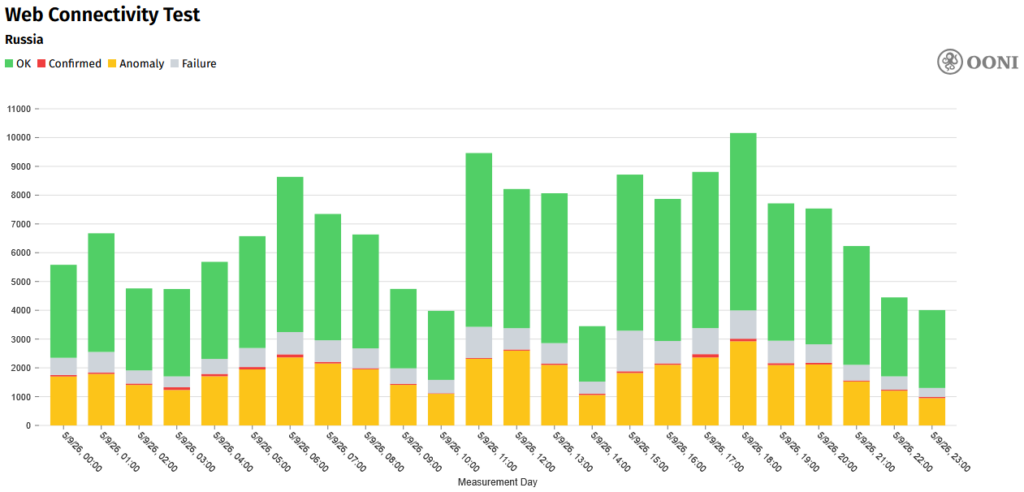
According to OONI, anomalies followed the same pattern across all messengers and web traffic. This is typical of an infrastructure-level mobile network shutdown, not selective blocking of specific services.
Update, May 11: how communications and internet access worked in Russia from May 5 to May 11
The shutdown wave began on May 5, earlier than officially announced. In the morning, at around 8:00 AM MSK, mobile internet disappeared for subscribers of all four major operators MTS, MegaFon, Beeline, and T2) in Moscow. In St. Petersburg, restrictions had begun as early as the night of May 4. Even whitelisted websites — the resources that were supposed to stay up during restrictions — went dark. By noon on May 5, the Ministry of Digital Development announced the lifting of the block.
On May 7, the Ministry of Digital Development officially confirmed a total mobile internet shutdown for the holiday, with no exceptions — not even the whitelist or SMS. The plan was to keep home internet and Wi-Fi operational. It was the first time authorities had publicly announced a shutdown with no whitelist fallback — something previously treated as a baseline guarantee.
On May 9, the shutdown followed the announced scenario. Restrictions began in the morning, coinciding with the start of the parade on Red Square. According to data from independent OONI Explorer probes, the anomaly rate throughout May 9 was approximately 84% for Signal, 87% for Telegram, and 84% for WhatsApp. The total number of Web Connectivity measurements on May 9 was noticeably lower than on adjacent days (~60,000 compared to ~82,000–90,000). That drop reflects a sharp fall in mobile probe activity — people simply had no way to get online. Complaints on the Sboy.rf service presented an unexpected picture: complaints for mobile operators (37 for MTS for the day) were lower than for Rostelecom (106 complaints). The service explicitly flagged that “problems are observed” for Rostelecom, indicating that restrictions extended beyond mobile networks. After the parade ended, the Ministry of Digital Development announced the lifting of restrictions and the beginning of service restoration.
What remained after May 9. OONI data for May 10 shows that the situation for Signal remained almost unchanged. Anomalies stayed at around 84%, the same level as on May 5–8. This indicates that the May shutdowns were stacked on top of Signal’s existing permanent block. In a broader context, these events align with a trend documented by Human Rights Watch as early as March 2026: Russian authorities are increasingly using mobile internet shutdowns as a tool for what authorities call “ensuring security” at any mass event, expanding the practice from Moscow to dozens of regions. The May cycle of restrictions — lasting five consecutive days, including wired internet, SMS, and “whitelists” — became the largest planned shutdown in Russia since systematic monitoring began.
Thus, the real picture confirms the worst of the scenarios described: the restrictions affected not only mobile internet, but mobile communications as a whole. In Moscow, for example, even resources from the “whitelist” were inaccessible.
Mechanics
Technical rationale
Technically, based on the available reports, this does not appear to be a full internet shutdown. Rather, it looks like targeted restrictions on mobile data at the infrastructure level. In some scenarios, this could extend to SMS and almost all mobile communications.
In practice, this means degradation of everything that depends on a mobile connection: messengers, navigation apps, taxis, banking push notifications, two-factor authentication codes — essentially everything requiring stable data transmission or SMS.
Another important part of the mechanics is “whitelisting,” meaning a set of resources that remain accessible even under restrictions of the mobile internet. This system operated in Moscow in March 2026, when mobile internet was unavailable in several city districts for weeks. However, the May restrictions may be more aggressive than before.
Legal rationale
From a legal perspective, the public justification centers on the formula of “ensuring security measures.” The Kremlin previously stated that communications shutdowns and restrictions take place “in strict accordance with current legislation.”
Publicly, this usually relies on a broad set of regulations covering security, counterterrorism powers, telecommunications network management during emergencies, and telecom operators’ obligations to follow orders from authorized bodies. However, the authors of publications about internet restrictions ahead of May 9 do not cite any specific legal act.
Additional Factors to Consider
Restrictions on mobile communications in Moscow have already caused significant daily and economic disruption, even under milder scenarios. During the March shutdown, Muscovites and visitors to the capital began buying more paper atlases, guidebooks, walkie-talkies, and pagers. Voice traffic and SMS messaging also increased. An IT market source told Kommersant (a leading Russian business newspaper) that the damage from the internet shutdown in Moscow was approximately 1 billion rubles (about $13 million) per day.
This means that even a short-term restriction on mobile internet can disproportionately affect everyday services: navigation, delivery, authentication, cashless payments, meeting coordination, and urban logistics. The risk is higher for journalists, observers, volunteers, and people working “in the field” because the shutdown breaks an entire chain of digital dependencies rather than just a single service, potentially making their work impossible.
How to Mitigate the Impact
Unfortunately, anti-censorship service developers do not have many options beyond the obvious approach of routing traffic through whitelisted IP addresses.
One option is to develop a custom transport layer that works through the APIs of allowed services. In this case, the application can use allowed services as a wrapper for exchanging encrypted packets. It sends small encrypted fragments — potentially utilizing steganography — as messages, attachments, or notifications. On the receiving end, a bridge service reassembles the fragments and forwards them into the application’s regular infrastructure.
The scheme looks like this:
Application ↔ transport adapter ↔ allowed platform ↔ bridge ↔ Service (or Application)
Additionally, SMS can serve as a fallback data channel.
Sources
- The Moscow Times. “Authorities Decided to Shut Down All Mobile Communications in Moscow Before May 9.” April 28.
- DW. “No Military Hardware at Moscow’s May 9 Parade.” April 28.
- Kommersant. “Mobile Internet Shutdowns Planned in Moscow for the May Holidays.” April 29.
- Meduza. “Telecom Operators Warn of Mobile Internet Shutdowns in Moscow May 5–9.” May 4.
- Meduza. “St. Petersburg Residents Warned of Mobile Internet ‘Difficulties’ Before May 9, Following Moscow.” May 4.
- Istories (Important Stories). “Vladimir Putin Fears Assassination and Coup; Conflict Among Security Services Is Growing, EU Intelligence Reports.” May 4.
- Meduza LIVE. Mobile Internet Shutdowns Begin in Moscow and St. Petersburg. May 5.
- Meduza LIVE
- RBC
- Meduza LIVE
- Seti i Signaly (Networks and Signals)
- News.ru
- Amnezia Pulse
- Interfax
- Fontanka
- Meduza
- The Bell
- BBC Russian
- Kyiv Independent
- Human Rights Watch
- OONI Explorer
- Amnezia Pulse